
Source of financing: National Science Center in Poland,
Number: 2020/39/B/HS6/03324
Project Duration: 2021 - 2027
Principal investigator: Michał Kuniecki, Emotion and Perception Lab, Institute of Psychology, Jagiellonian University in Krakow
Team:
Laurent Beaupoil, Doctoral School in the Social Sciences, Jagiellonian University, Krakow
Beata Pacula-Leśniak, Doctoral School in the Social Sciences, Jagiellonian University, Krakow
Tomasz Kulczycki, Doctoral School in the Social Sciences, Jagiellonian University, Krakow
Agata Szymańska, Doctoral School in the Social Sciences, Jagiellonian University, Krakow

Project Overview
With the rapid growth of digital misinformation and generative AI, distinguishing between real and fake photojournalism has become a critical challenge. In this project, we examine how specific content categories, attention deployment, and emotional reactions shape authenticity judgments of photojournalistic images. Because photographs are processed rapidly and treated as direct evidence, they profoundly influence public perception, yet our ability to discern real images from altered ones is very limited. Prior research indicates that image authenticity judgment can be predicted by emotional responses. Building on our preliminary findings, we combine lab-developed image content using meaning maps with eye-tracking and physiological arousal measures to investigate how visual attention and emotional resonance drive perceived reality. Through gaze-contingent experiments, we assess how focusing on specific content alters credibility judgments.

Stage I
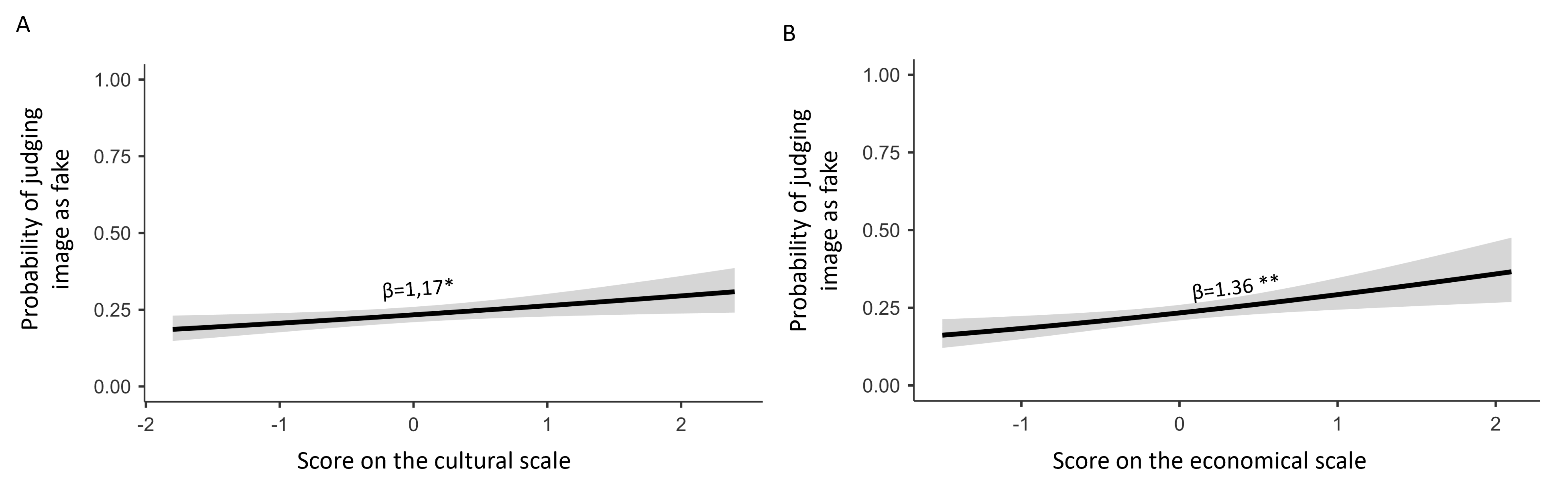
In this foundational study, we investigated how political orientation and evoked emotions shape the perceived authenticity of photojournalistic photographs. Evaluating responses from a representative sample of the Polish population, we found that political orientation significantly predicts authenticity judgments and confidence, with right-leaning individuals showing heightened skepticism and a greater tendency to classify genuine images as fake. Furthermore, analyzing the specific emotional responses elicited by the photographs revealed that emotions cluster into distinct affective components (following a two-dimensional model of affect): while "cold" negative emotions (such as sadness and compassion) and positive emotions bolster perceived truthfulness, "hot" negative emotions (such as anger and disgust) trigger skepticism and drive the perception of falsity. These findings highlight how individual ideological and emotional biases fundamentally alter how visual media is evaluated in a media landscape saturated with misinformation.
Stage II

In this study, we investigated how specific content categories present in photojournalistic images influence human authenticity judgments. By combining thematic analysis with Large Multimodal Models (Mistral's Pixtral 12B), we trained machine learning classifiers to predict whether an image would be perceived as real or fake with over 75% accuracy. Our findings reveal that features like poverty and natural disasters strongly enhance perceived realism, whereas elements such as protests, fire or movement degrade it .
Research Team & Collaboration
About the Researcher
Laurent Beaupoil is a Cognes doctoral candidate and holds an MA, having graduated from the International Master in Neuroscience in Bordeaux, France.
He has a specific interest in sensory perception, more particularly visual perception and their underlying circuits, and has hands-on experience in using eye-tracking, pupillometrics, and machine learning to study these interests.
He has a specific interest in sensory perception, more particularly visual perception and their underlying circuits, and has hands-on experience in using eye-tracking, pupillometrics, and machine learning to study these interests.
Opportunities for students
We are looking for motivated undergraduate or master’s students (e.g., from cognitive science, psychology, or computer science) to join the "Is it fake?" project and gain hands-on experience with:
- Eye-tracking experiments and analyzing visual attention patterns and meaning maps.
- Psychophysiological data collection (measuring physiological arousal, pupillometry, and emotional responses).
- Behavioral data analysis investigating how image content and emotional framing shape the perceived authenticity of photojournalistic photographs.

Contact
laurent.beaupoil@doctoral.uj.edu.pl