
How Avatars and Virtual Environments Impact Our Cognitive Performance
Studying the complex mechanics of the human mind requires tools that seamlessly blend rigorous experimental control with ecological validity. In our lab, we are launching a research project that leverages immersive Virtual Reality (VR) to investigate how digital embodiment and environmental cues can activate—or mitigate—the psychological phenomenon known as Stereotype Threat.
This project sits at the intersection of social psychology, cognitive neuroscience, and advanced human-computer interaction, focusing on two powerful phenomena:
Stereotype Threat (ST): The psychological tension or anxiety an individual experiences when they risk confirming a negative stereotype about a social group they identify with. This induced stress taxes working memory and often impairs performance on demanding tasks.
The Proteus Effect: The fascinating behavioral and psychological shift that occurs when individuals adopt a digital avatar. Users unconsciously alter their behavior to align with the stereotypical traits of their virtual body.
We aim to explore how gendered aspects of VR scenarios, specifically avatar gender-swapping (identity masks) and gender-coded environments influence users' physiological and cognitive responses during tasks susceptible to gender stereotypes.
This project sits at the intersection of social psychology, cognitive neuroscience, and advanced human-computer interaction, focusing on two powerful phenomena:
Stereotype Threat (ST): The psychological tension or anxiety an individual experiences when they risk confirming a negative stereotype about a social group they identify with. This induced stress taxes working memory and often impairs performance on demanding tasks.
The Proteus Effect: The fascinating behavioral and psychological shift that occurs when individuals adopt a digital avatar. Users unconsciously alter their behavior to align with the stereotypical traits of their virtual body.
We aim to explore how gendered aspects of VR scenarios, specifically avatar gender-swapping (identity masks) and gender-coded environments influence users' physiological and cognitive responses during tasks susceptible to gender stereotypes.
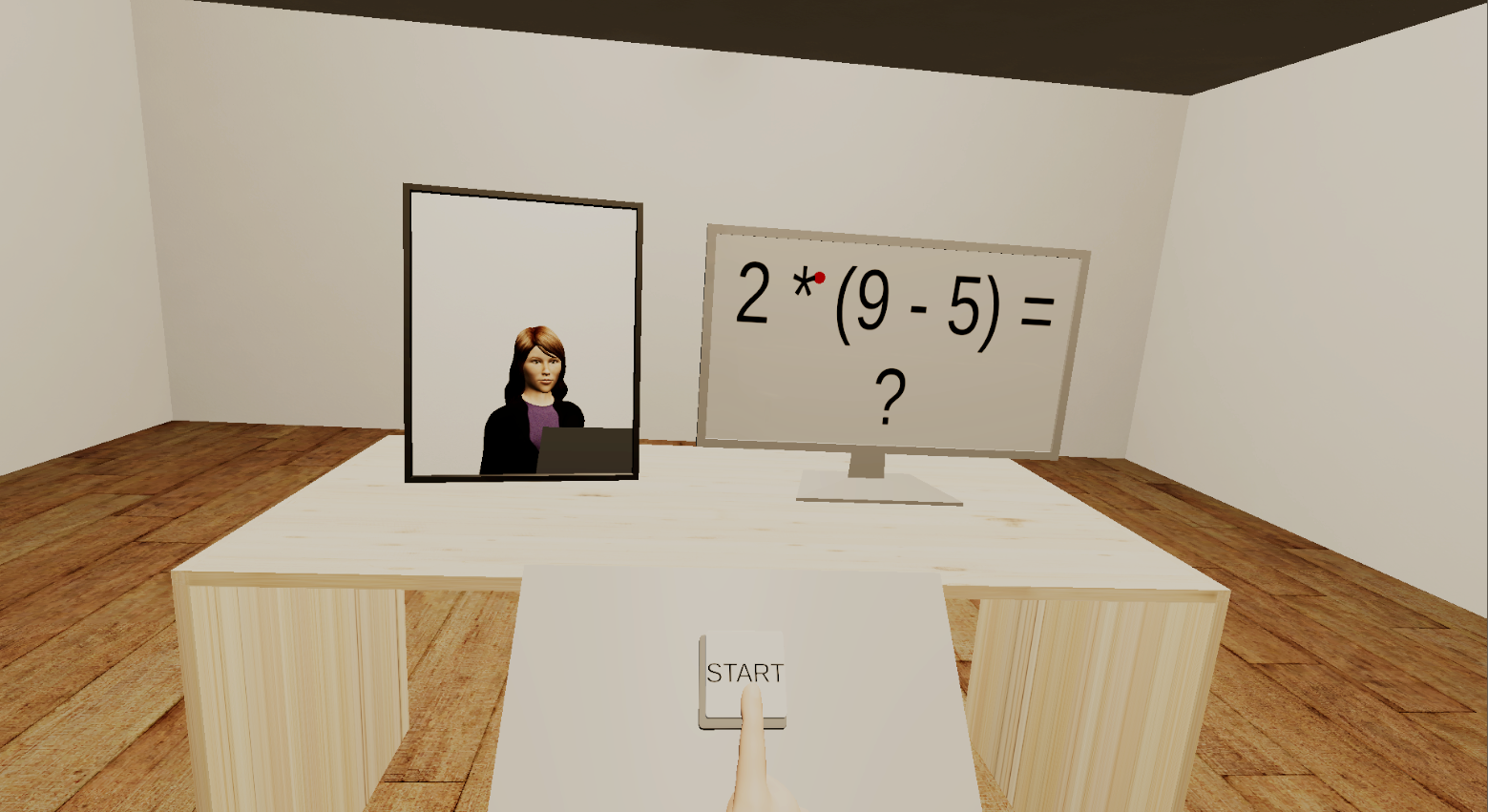

Overview of the experimental platform interface, showing the participant’s first-person VR perspective during the math phase of the Aospan task (bottom), synchronized with real-time pupil dilation data (top right) and the server log for psychophysiological data triggers (top left).
Hardware & Technical Infrastructure
Immersive VR and psychophysiological tracking integration
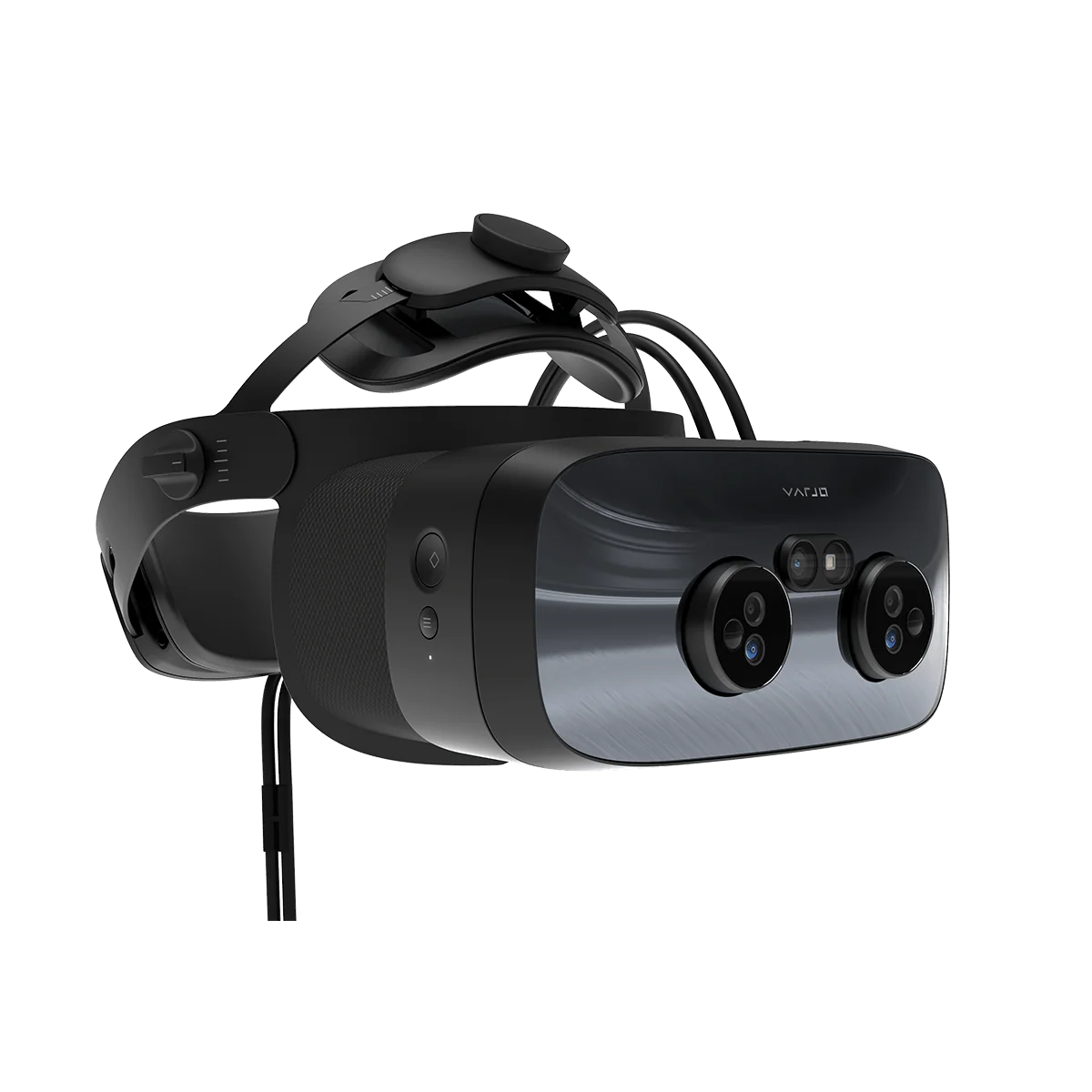
To ensure high internal validity and robust data collection, the experimental platform is deployed using the research-grade Varjo XR-3 head-mounted display (HMD) integrated with Unity and SteamVR. The technical infrastructure relies on several key features of the hardware:
Photorealistic Visual Fidelity: The headset provides human-eye resolution (over 70 PPD) and a 115° field of view. This high visual clarity prevents artificial artifacts and ensures that the virtual environment triggers authentic self-embodiment rather than simple situational priming.
Integrated 200 Hz Eye Tracking: Built-in eye-tracking cameras capture gaze data and real-time pupillometry at 200 Hz. This allow us to use precise pupil dilation variations as an objective index of cognitive load and emotional arousal during the tasks.
Controller-Free Hand Tracking: Embedded Ultraleap technology enables natural hand tracking, allowing participants to interact with the task interface using a virtual keyboard without physical controllers.
Ergonomics & Data Stability: Automatic IPD adjustment and active cooling minimize eye strain and simulator sickness, preserving data quality and reducing participant dropout rates during long testing blocks.
Photorealistic Visual Fidelity: The headset provides human-eye resolution (over 70 PPD) and a 115° field of view. This high visual clarity prevents artificial artifacts and ensures that the virtual environment triggers authentic self-embodiment rather than simple situational priming.
Integrated 200 Hz Eye Tracking: Built-in eye-tracking cameras capture gaze data and real-time pupillometry at 200 Hz. This allow us to use precise pupil dilation variations as an objective index of cognitive load and emotional arousal during the tasks.
Controller-Free Hand Tracking: Embedded Ultraleap technology enables natural hand tracking, allowing participants to interact with the task interface using a virtual keyboard without physical controllers.
Ergonomics & Data Stability: Automatic IPD adjustment and active cooling minimize eye strain and simulator sickness, preserving data quality and reducing participant dropout rates during long testing blocks.
Research Team & Collaboration
About the Researcher
Agata Szymańska is a PhD candidate specializing in cognitive neuroscience at the Jagiellonian University. Her research sits at the intersection of social psychology, cyberpsychology, and psychophysiology, with a specific focus on virtual reality (VR) embodiment and the Proteus effect.
With a background spanning cognitive science and social communication, she leverages multimodal physiological tracking (ECG, EDA, and pupillometry) to study how immersive digital identities modulate cognitive load and stereotype threat. Her work on this project was reviewed and presented at the IEEE VR Doctoral Consortium.
With a background spanning cognitive science and social communication, she leverages multimodal physiological tracking (ECG, EDA, and pupillometry) to study how immersive digital identities modulate cognitive load and stereotype threat. Her work on this project was reviewed and presented at the IEEE VR Doctoral Consortium.
Opportunities for students
We are looking for motivated undergraduate or master’s students (e.g., from cognitive science, psychology, or computer science) who want to gain hands-on experience with:
- Running experimental sessions using high-end VR hardware (Varjo XR-3).
- Psychophysiological data collection (EDA, HR, Eye-Tracking).
-Unity-based virtual environment adjustments.
- Running experimental sessions using high-end VR hardware (Varjo XR-3).
- Psychophysiological data collection (EDA, HR, Eye-Tracking).
-Unity-based virtual environment adjustments.

Contact
agata.szymanska@doctoral.uj.edu.pl